
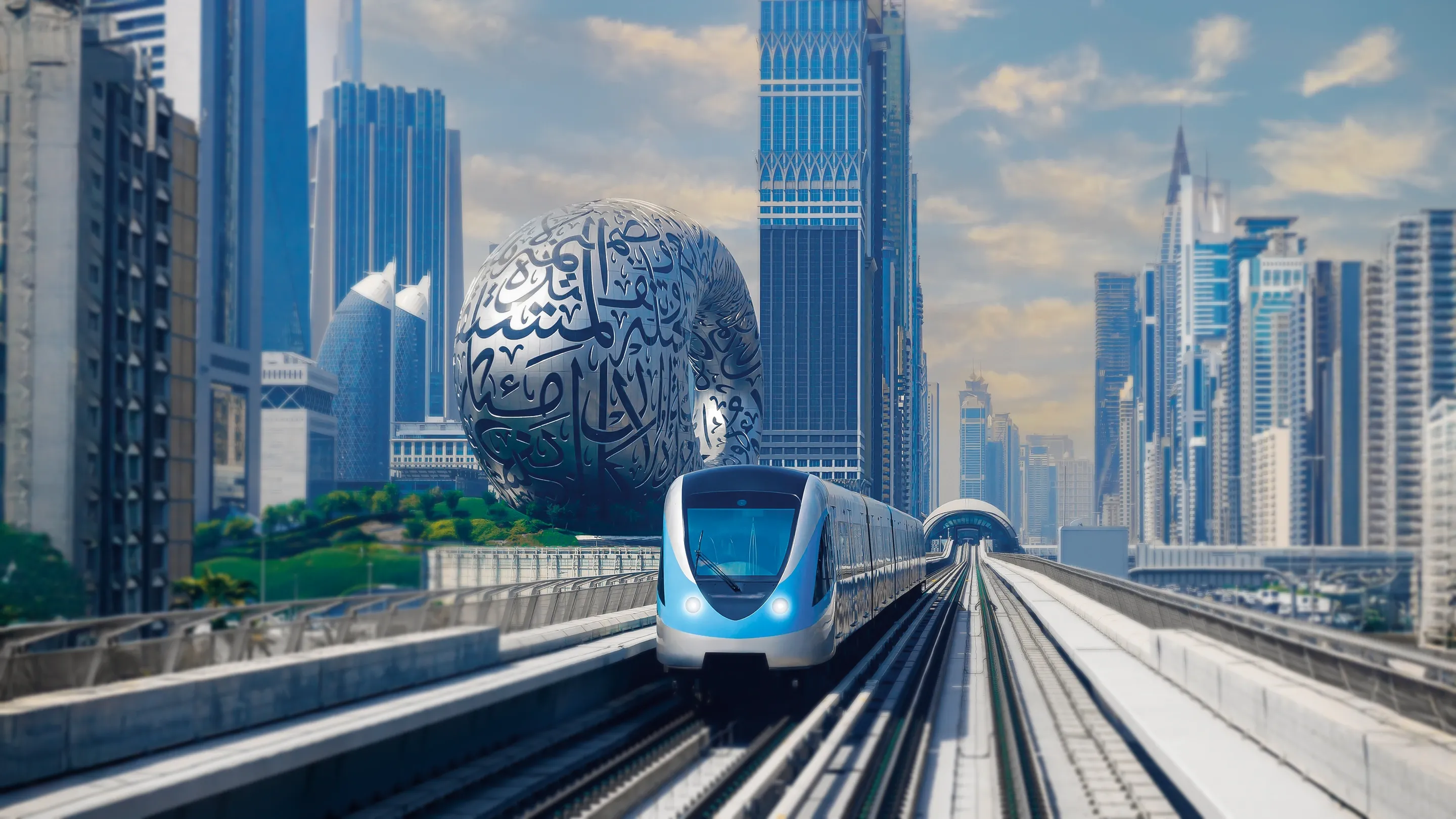

Dubai’s Metro network is entering one of its biggest periods of change since the system opened in 2009.
New lines are under construction. One of the network’s busiest stations is being expanded. The Nol payment system is moving towards account-based ticketing. Existing infrastructure is being upgraded, and longer-term rail proposals could connect more residential communities, airports, and national transport networks.
For residents, these changes are about shorter journeys and easier travel. For buyers and investors comparing Dubai properties, they also offer clues about how the city is planning its next phase of growth.
Transport infrastructure does not determine property performance on its own. Yet connectivity can influence where people choose to live, how easily they commute, and how attractive a community becomes to tenants and end-users.
Here are seven major Dubai Metro upgrades worth watching, what has been confirmed, and what they could mean for the city’s property market.
Upcoming Dubai Metro Upgrades in 2026
The upcoming Dubai Metro upgrades in 2026 cover more than new tracks and stations. The wider programme includes digital ticketing, station capacity, escalator modernisation, new rail connections, and future route studies.
The scale matters because Dubai continues to grow across multiple directions at once. Established districts are becoming denser, while communities further from the traditional city centre are attracting more residents and investment.
A stronger transport network helps connect these growth areas to employment hubs, airports, retail destinations, and leisure districts. For Dubai properties, that can gradually change how buyers evaluate location.
A community that once depended heavily on private cars may become more accessible. An established station may handle higher passenger volumes. A new interchange may connect local travel with the wider UAE.
The result is a city where property decisions are increasingly linked to mobility planning.
1. The Nol Card System Is Moving Towards Account-Based Ticketing
One of the most immediate changes will affect how people pay for public transport.
Dubai’s Nol systemis moving from traditional card-based ticketing towards an account-based payment model. According to the latest information in the supplied July 2026 reference, the programme had reached 72% completion, with the upgraded system targeted for completion in the first quarter of 2027.
The rollout is expected to take place in three phases.
Phase One Introduces QR Ticketing
Passengers will be able to access QR code tickets through digital channels, reducing dependence on a physical card for every journey.
Phase Two Introduces a New Generation of Nol Cards
The next generation of Nol cards will be linked to customer accounts and built around payment technologies compatible with modern banking standards.
Phase Three Adds Bank Cards and Digital Wallets
The final stage is expected to allow public transport fares to be paid using bank cards and digital wallets.
The upgraded system is also expected to support features such as linked family cards, automatic top-ups, transaction records, card blocking, and balance recovery.
For residents, this is a practical improvement. For the property market, the effect is more indirect.
Easier transport payments can make the wider public transport system more convenient to use. When buyers compare Dubai properties, that convenience becomes part of the everyday experience of a location, especially for professionals, students, tourists, and residents who do not want to depend entirely on a car.
2. Every Dubai Metro Escalator Is Being Upgraded
Some of the most important transport improvements are the ones passengers barely notice when they work well.
An ongoing programme is upgrading escalators across Dubai Metro stations to improve reliability, safety, and passenger comfort. According to the July 2026 reference supplied for this article, 63% of the network’s escalators had already been upgraded.
This may appear minor compared with building an entirely new Metro line, but network quality depends on daily reliability.
For passengers moving through busy stations, especially families, older residents, tourists with luggage, and people transferring between transport modes, station infrastructure directly affects the travel experience.
For Dubai properties near existing Metro stations, continued investment in the current network matters. A mature transport system must maintain and improve what already exists while expanding into new communities.
That balance helps established Metro-linked districts remain practical as passenger numbers grow.
3. The Dubai Metro Blue Line Is Coming in 2029
Among all the new Dubai Metro lines and stations currently planned, the Blue Line is the most significant confirmed expansion.
The 30-kilometre route will include 14 stations and connect growing communities in the eastern and north-eastern parts of Dubai with the existing Metro network. The line is scheduled to begin operations in 2029.
Dubai Metro Blue Line Latest Update
The Dubai Metro Blue Line latest update confirms that the project will create new connections across areas including Dubai Creek Harbour, Dubai Festival City, International City, Dubai Silicon Oasis, and Dubai Academic City, with interchanges connecting the new route to the existing network.
The line will include both underground and elevated sections. One of its most prominent features will be the station at Dubai Creek Harbour, planned as a 74-metre-high Metro station.
The wider significance of the Blue Line is the number of residential and employment districts it will bring closer to rail-based public transport.
For buyers comparing Dubai properties, this is where infrastructure research becomes useful.
A future Metro station should never be treated as a guarantee of capital appreciation. Property performance still depends on purchase price, supply, developer quality, service charges, rental demand, and the wider community.
However, improved connectivity can change how practical a location becomes for residents.
A professional who previously needed to drive for most journeys may gain a rail connection. A student may have easier access to an academic district. A tenant may be able to reach an interchange without relying on multiple transport modes.
These changes can broaden the pool of people willing to consider living in a community.
4. Burj Khalifa and Dubai Mall Metro Station Is Getting a Major Expansion
Dubai is also increasing capacity where demand is already high.
The Burj Khalifa/Dubai Mall Metro Station is being expanded by 65%, with planned improvements to entrances, pedestrian bridges, concourse areas, escalators, and lifts.
Once completed, hourly passenger capacity is expected to increase from 7,250 to 12,320, while the station is being designed to accommodate up to 220,000 passengers per day.
This upgrade highlights an important part of Dubai’s transport strategy.
Growth is not limited to extending the city outward. Established destinations also need greater capacity as resident and visitor numbers increase.
For property buyers, this matters because infrastructure pressure can affect the daily experience of even the most established locations. Expanding a heavily used station can help an existing district absorb more movement without relying solely on road transport.
It also demonstrates why buyers should look beyond whether a community has a Metro station. Capacity, interchanges, pedestrian access, and the wider journey experience matter too.
5. A Future Gold Line Could Add Another Major East-to-West Connection
The proposed Gold Line is one of the most closely watched longer-term Metro plans, but buyers should distinguish between reported plans and officially confirmed station details.
Current reports describe a potential fully underground line of approximately 42 kilometres with 18 stations, intended to connect several major areas across Dubai and potentially serve around 1.5 million residents.
Reported maps and coverage have suggested possible connections through areas such as Business Bay, Meydan, Dubai Hills, Global Village, Jumeirah Village Circle, Dubai Production City, and Jumeirah Golf Estates.
However, the supplied reference explicitly notes that the exact station locations had not been officially confirmed by the RTA at the time of publication.
That distinction is important for property investors.
Future infrastructure can influence expectations long before a project opens, but investment decisions should not be based on an unconfirmed station location.
For buyers evaluating Dubai properties in areas linked to future transport plans, the sensible approach is to separate:
- Confirmed projects under construction
- Officially announced routes
- Proposed lines under planning or study
- Speculative station locations
This helps prevent future infrastructure from being treated as a current property feature.
If the Gold Line progresses as reported, it could significantly improve east-to-west connectivity across several established and emerging communities. Until route and station details are formally confirmed, however, buyers should treat specific location claims with caution.
6. Dubai Metro Will Connect with Etihad Rail Passenger Services
Dubai’s transport story is also becoming part of a wider national network.
The planned connection between Dubai Metro and Etihad Rail passenger services could make it easier for residents to move between local public transport and inter-emirate rail.
According to the supplied July 2026 reference, Jumeirah Golf Estates is expected to provide an interchange between the national passenger railway and the Dubai Metro Red Line. The same source notes that a future interchange at Meydan has appeared in planning material, although the second Dubai passenger station had not yet been confirmed.
For Dubai properties, national rail connectivity could gradually widen the meaning of a "well-connected" location.
Today, property connectivity is often measured by road access, distance to the Metro, and proximity to major business districts.
In the future, some buyers may also consider how easily a home connects to inter-emirate travel.
That could be particularly relevant to professionals whose work spans multiple emirates, residents who travel frequently within the UAE, and businesses seeking access to a broader labour and customer base.
7. An Airport Express Line Is Being Studied
One of the most ambitious proposals is a potential express Metro connection between Dubai International Airport and Al Maktoum International Airport.
Reports cited in the supplied reference describe a possible 55-kilometre line connecting DXB and DWC, with proposed links through areas including Al Jaddaf, Al Khail Road, and Jumeirah Village Circle.
However, this project requires careful wording.
The reference states that consultants had reportedly been invited to study and design an Airport Express Line, while the RTA had not officially confirmed the project at the time of publication.
For buyers and investors, this is a useful example of why due diligence matters.
A transport corridor under study is different from a line under construction.
If an airport-to-airport connection eventually proceeds, it could become an important piece of Dubai’s long-term mobility network, particularly as development around Al Maktoum International Airport continues.
For now, it should be viewed as a proposal to watch rather than a confirmed connectivity benefit for any particular Dubai property.
New Dubai Metro Lines and Stations Could Change How Buyers Evaluate Location
The new Dubai Metro lines and stations planned for the coming years show how quickly Dubai’s map of accessibility can change.
Traditionally, buyers have often evaluated location using distance from Downtown Dubai, major roads, or the coastline.
Those measures still matter, but the next generation of property decisions may increasingly consider:
The key is to evaluate connectivity as part of the complete property decision rather than in isolation.
A Metro station cannot compensate for an unsuitable layout, excessive service charges, poor build quality, or an inflated purchase price.
But when good connectivity is combined with a well-planned home and a community people genuinely want to live in, it can strengthen long-term appeal.
What the Metro Expansion Means for Tranquil Developments
For Tranquil Developers, the wider transport story reinforces the importance of selecting locations with long-term relevance.
Blossom 40 in Majanis a boutique development offering 1.5 and 2.5-bedroom apartments designed around usable space, natural light, wellness-focused amenities, and everyday comfort. The development is positioned within Majan’s growing residential environment, with access to major road networks and destinations such as Global Village and IMG Worlds of Adventure.
Blossom 76 is positioned in Jumeirah Village Circle, a community that continues to attract buyers and tenants because of its established residential infrastructure and access to key parts of Dubai.
For both projects, the investment case should remain grounded in what exists today, while future infrastructure is treated with the appropriate level of certainty.
That approach reflects Tranquil’s "Built With Thought" philosophy. Location decisions are considered alongside liveability, wellness, usable design, and long-term value rather than relying on a single future announcement.
Connectivity Is Becoming a Bigger Part of the Property Decision
Dubai’s next Metro chapter is about more than adding stations.
It is about making the existing network easier to use, increasing capacity where demand is highest, connecting new communities, and gradually linking local transport with a wider national mobility system.
For people comparing Dubai properties, these upgrades add another layer to the decision-making process.
The strongest property choices are rarely based on one future promise. They come from looking at the complete picture: the home, the community, current accessibility, confirmed infrastructure, ownership costs, and how people are likely to live there over time.
That is where thoughtful property development and thoughtful investing meet.
FAQs
What are the main upcoming Dubai Metro upgrades in 2026?
The upcoming Dubai Metro upgrades in 2026 include the continuing Nol payment overhaul, Metro escalator upgrades, expansion of the Burj Khalifa/Dubai Mall station, construction of the Blue Line, and planning around future rail connections.
What is the Dubai Metro Blue Line latest update?
The Dubai Metro Blue Line is a confirmed 30-kilometre expansion with 14 stations. It is scheduled to begin operations in 2029 and will connect several growing communities to the existing Metro network.
What new Dubai Metro lines and stations are planned?
The Blue Line is the major confirmed expansion currently moving forward. A Gold Line and Airport Express connection have also been reported, but some route and station details remain unconfirmed.
Can new Metro stations increase the value of Dubai properties?
Improved transport access can make communities more convenient and attractive to residents, but there are various factors affecting property value. Purchase price, supply, rental demand, developer quality, service charges, and the wider community should all be considered.
Will the Nol card be replaced?
The system is moving towards account-based ticketing, with QR tickets, new-generation Nol cards, bank card payments, and digital wallets expected to provide more payment options.
When will the Dubai Metro Blue Line open?
The Blue Line is scheduled to begin operations in 2029.
Should investors buy Dubai properties based on proposed Metro routes?
Investors should distinguish between confirmed infrastructure and projects that are still proposed or under study. A possible future station should not be treated as a guaranteed investment benefit until official details are confirmed.
Disclaimer
Metro routes, station locations, project timelines, completion percentages, passenger capacity figures, and proposed infrastructure referenced in this article are based on publicly available reports and supplied reference material available as of July 2026. Some future projects, including specific Gold Line stations and the proposed Airport Express Line, had not been fully confirmed by the RTA at the time of writing. Infrastructure plans and timelines may change. Buyers and investors should verify the latest information with the relevant authorities before making property decisions.

Author: Dr. Sharad Nair
Co - Founder & Chairman, Tranquil Developers


